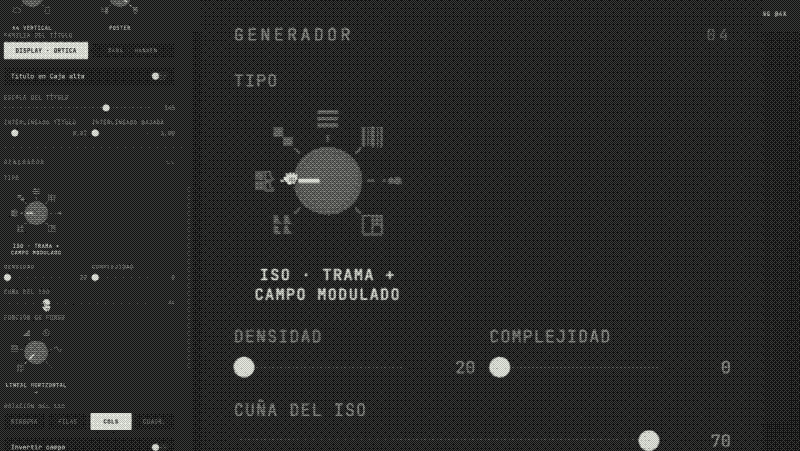
What if, instead of letting AI take the fun out of design, we use it to build custom design tools? What if, instead of replicating a traditional tool, we build it like a synthesizer—one that, instead of modulating sound waves, uses a pair of vector oscillators that can be filtered and processed?
En Laburo Estudio nos planteamos eso, y lo que comenzó como un experimento terminó en un generador visual que nos permite operar con nuestro sistema gráfico tal como nosotros queremos, y exportarlo para seguir iterándolo manualmente en Figma o Illustrator.
Our design system isn’t very complex, but as grid density increases, execution becomes increasingly laborious. It focuses on five operations applied to the Iso (serialization, rotation, scaling, deformation, and mirroring) through which grid density is modulated, playing with the optical effect generated by a dark background plane behind the Iso filled with the light background color. We didn’t invent anything new; like the hard-working folks we are, we identify with a brutalist aesthetic influenced by Enzo Mari, the Manuel Belgrano school in Córdoba, the roofs of FADU…
The first iterations were complete crap. The AI didn’t understand the Iso; it invariably tended to see it as an ‘L’ or as the counterform of the ‘L’. Nor did it understand how these optical effects were produced between the background and the Iso. In other words, it understood nothing. So, as if explaining it to a “Junior Assistant to the Junior Designer,” we took a step-by-step teaching approach: we fed it many images we had designed by hand and recorded each sequence of the process, explaining operation by operation how we arrived at that result, so that once it digested it, we could define which variables needed to be manipulated from the tool to give us the versatility we were looking for.
It was a long and frustrating process, but as the hours went by and with a heavy token burn, we started getting decent results. Today we have a tool that keeps iterating, but fulfills what we set out to do: generate grids, modulate them to our liking, randomize them, and bring them into Illustrator or Figma. Using AI to speed things up, without losing the craft.
We might not have built an AI that makes your bed and washes your dishes, but for us, it’s pretty close.